
Teeth whitening does not change the colour of dental crowns, veneers, or composite bonding. This is the central fact that determines how whitening fits — or doesn’t fit — into a smile with existing restorations.
Key Takeaways
- Whitening agents work on natural enamel only — they have no effect on porcelain, zirconia, or composite restorations.
- Whitening first, then replacing any visible restorations, is the approach most dentists recommend.
- Timing, shade matching, and budget all affect whether the sequence makes clinical sense.
- Attempting to whiten after restorations are placed can create a noticeable colour mismatch.
Why Restorations Don’t Respond to Whitening
Carbamide peroxide and hydrogen peroxide — the active ingredients in whitening treatments — work by penetrating the porous enamel structure and oxidising stain molecules within the tooth. Porcelain, ceramic, and composite resin do not have the same porous structure, so the chemistry has no surface to work on.
The colour of a crown or veneer was set at the time of fabrication. It is fixed. Professional whitening, whether performed in a dental office or with a take-home tray, will not lighten it.
The Shade-Matching Problem
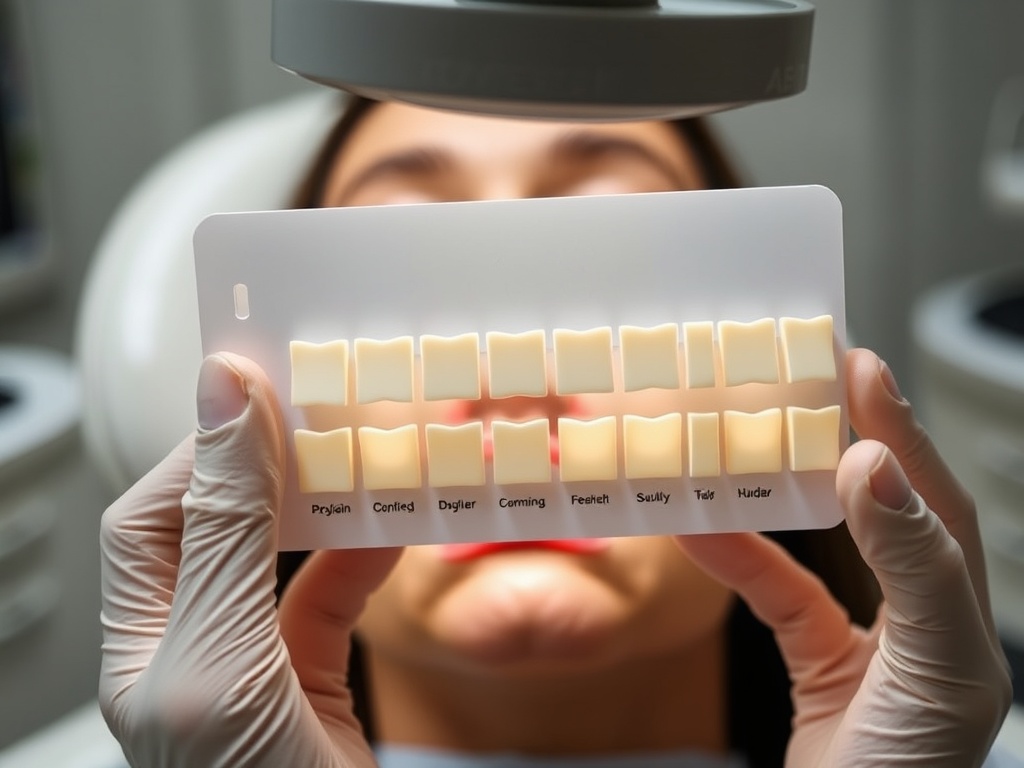
If your natural teeth respond to whitening and become noticeably lighter, any existing crowns or veneers on visible teeth will appear darker or more yellow by comparison. This mismatch is most obvious on front teeth. It can create the impression that certain teeth look artificial even when the restorations themselves are well-made.
This is not a cosmetic problem without a solution — but it does require planning.
The Standard Recommended Sequence
Most dentists who manage cosmetic treatment recommend this order:
- Whiten natural teeth first to the desired shade
- Allow two to four weeks for shade stabilisation (newly whitened teeth can shift slightly as they rehydrate)
- Have crowns, veneers, or composite bonding placed or replaced at the stabilised shade
This sequence ensures that new restorations are matched to the whitened baseline rather than the pre-whitening baseline.
Budget and Timing Considerations
| Scenario | What to Consider |
|---|---|
| Existing restorations are on back teeth only | Whitening front natural teeth may be straightforward — shade match less critical |
| Restorations are on visible front teeth | Replacement will likely be needed after whitening for a uniform result |
| Restorations are old and due for replacement anyway | Plan replacement after whitening — budget for new restorations at the whitened shade |
| Budget is limited right now | Whitening alone improves natural teeth; revisit restoration replacement when possible |
If the cost of replacing restorations feels significant, discussing it with your dentist in the context of a broader plan is worthwhile. Understanding how dentists structure and stage complex treatment can help you see how cosmetic work fits alongside functional or restorative priorities.
What About Composite Bonding?
Composite resin — used in bonding, tooth-coloured fillings, and some veneers — also does not respond to whitening agents. Some patients notice that whitening makes surrounding natural teeth brighter while the composite remains the original colour. Again, the solution is whitening first, then replacing the composite at the new shade.

Short-Term Steps If You’re Not Ready to Replace Restorations
If whitening is desirable but restoration replacement is not feasible right now, a dentist may suggest:
- Whitening only the teeth without visible restorations
- Using a lighter professional whitening shade that brings natural teeth closer to the restoration shade without surpassing it
- Delaying whitening until restoration replacement can be coordinated
Before You Begin
If you are considering whitening and have crowns, veneers, or composite restorations on any front teeth, a brief consultation before beginning any whitening — in-office or at-home — is worthwhile. For context on how underlying tooth structure affects what restorations are possible, it helps to understand when a post and core is needed before a crown can be placed. And if technology-assisted shade matching is part of your dentist’s process, the comparison article on when traditional dental techniques still outperform newer technology offers useful perspective on that process.