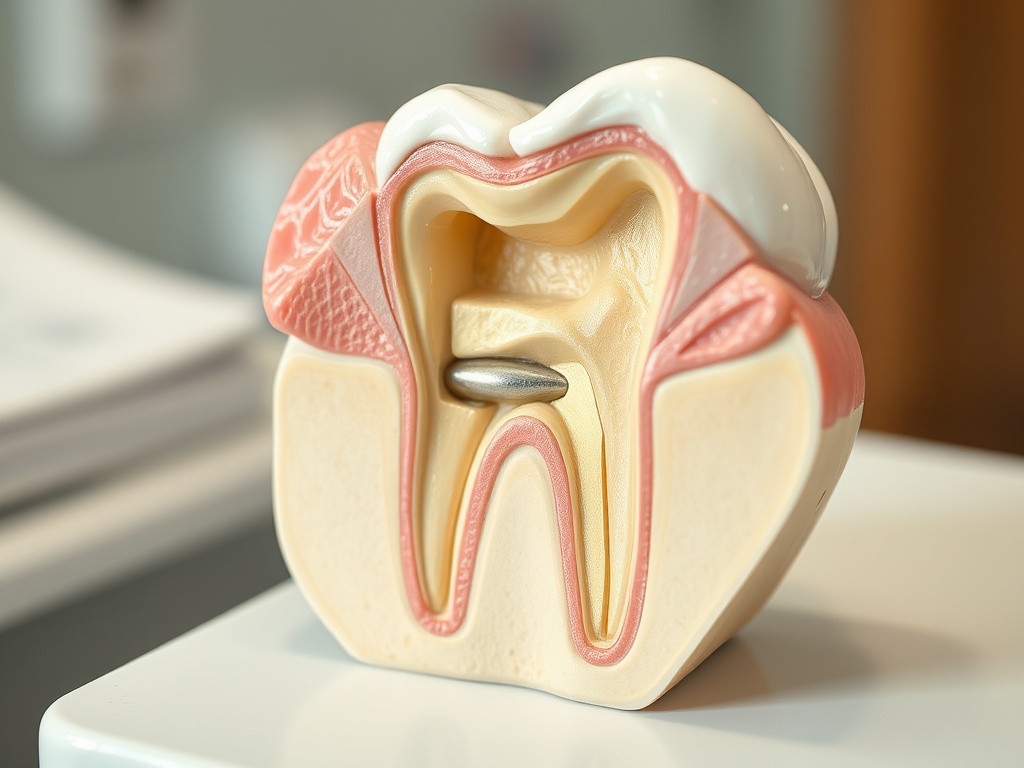

If your dentist has mentioned a “post and core” during an exam or treatment plan, you are likely dealing with a tooth that has lost substantial structure — and now needs an internal foundation before a crown can be placed.
Key Takeaways
- A post is placed inside a root canal to help anchor a core build-up when little natural tooth remains.
- The core is the restorative base onto which a crown is cemented.
- Not every crown needs a post — the decision depends on how much healthy tooth structure remains.
- Material choice, placement, and timing each affect how long the restoration lasts.
Where the Term Appears and What It Means
You are most likely to encounter “post and core” on a dental treatment plan after root canal therapy, following a tooth fracture, or when an old large filling has failed. Without enough sound tooth structure to grip, a crown has nothing reliable to bond to — the post and core solve that problem by creating an internal scaffold.
The post is a small, narrow component — metal or tooth-coloured fibre — inserted into the prepared root canal space. The core is a build-up of dental composite placed around the post and shaped to receive the crown. Together, they restore the tooth to a form that the crown can cap.
How It Affects Durability, Aesthetics, and Cost
| Factor | Metal Post | Fibre (FRC) Post |
|---|---|---|
| Material | Stainless steel or titanium alloy | Glass or carbon fibre reinforced composite |
| Aesthetics | Can show grey at gum margin under thin porcelain | Tooth-coloured; no shadow effect |
| Flexibility | Rigid; stress concentrates at root junction | Closer to natural tooth flexibility |
| Longevity evidence | Decades of clinical track record | Strong peer-reviewed evidence base; widely adopted |
| Relative cost | Generally lower material cost | Comparable or slightly higher |
The american association of endodontists notes that when substantial coronal structure is lost after endodontic treatment, a post may be needed — but emphasises that the decision should be based on the amount of remaining tooth tissue rather than applied routinely.
When a Post Is and Isn’t Necessary
A post is not automatically required after every root canal. Dentists assess:
- How much natural tooth structure remains above the gumline
- The location of the tooth (anterior teeth face different forces than molars)
- Whether the remaining walls are thick enough to support the crown independently
Molars often have enough residual structure to retain a core build-up without a post. Front teeth that have experienced trauma often have less remaining structure and benefit from post placement.
Related Concepts Patients Often Confuse
Post and Core vs. Crown Alone
A crown on its own sits on the existing tooth preparation. A post and core is only placed when that preparation is insufficient. The crown still goes on top — the post and core simply create a more reliable base for it.
Post and Core vs. Implant
A dental implant replaces a missing tooth from the root up. A post and core restores a tooth that still has an intact root. If you are weighing whether to save a tooth with a post-and-core-and-crown versus extracting and replacing it, that comparison is also relevant when considering what happens when a dentist weighs extraction against root canal treatment.
Post and Core vs. Build-Up Alone
Sometimes enough tooth remains that a dentist can place a core build-up using composite resin without any post. This simpler approach is preferable when the remaining tooth walls provide enough retention on their own.
What to Ask Your Dentist
- How much of my natural tooth structure is left above the gumline?
- Are you recommending a fibre post or a metal post, and why?
- Would a build-up without a post be viable in my case?
- What is the long-term prognosis for this tooth with the proposed restoration?
If a crown is planned after a post and core, shade matching becomes important — especially if you have other restorations. Understanding whether whitening is possible when you have existing crowns or veneers will help you plan the cosmetic outcome of any new restorations alongside existing ones.

The Longer View
A properly placed post and core, combined with a well-fitted crown, can last many years — but the restoration is only as reliable as the root beneath it. Maintaining regular dental visits, managing grinding habits, and protecting the area from trauma all contribute to long-term success. If this procedure is part of a larger treatment sequence, understanding how dentists structure phased dental treatment can help you see where the post and core fits in the overall picture.