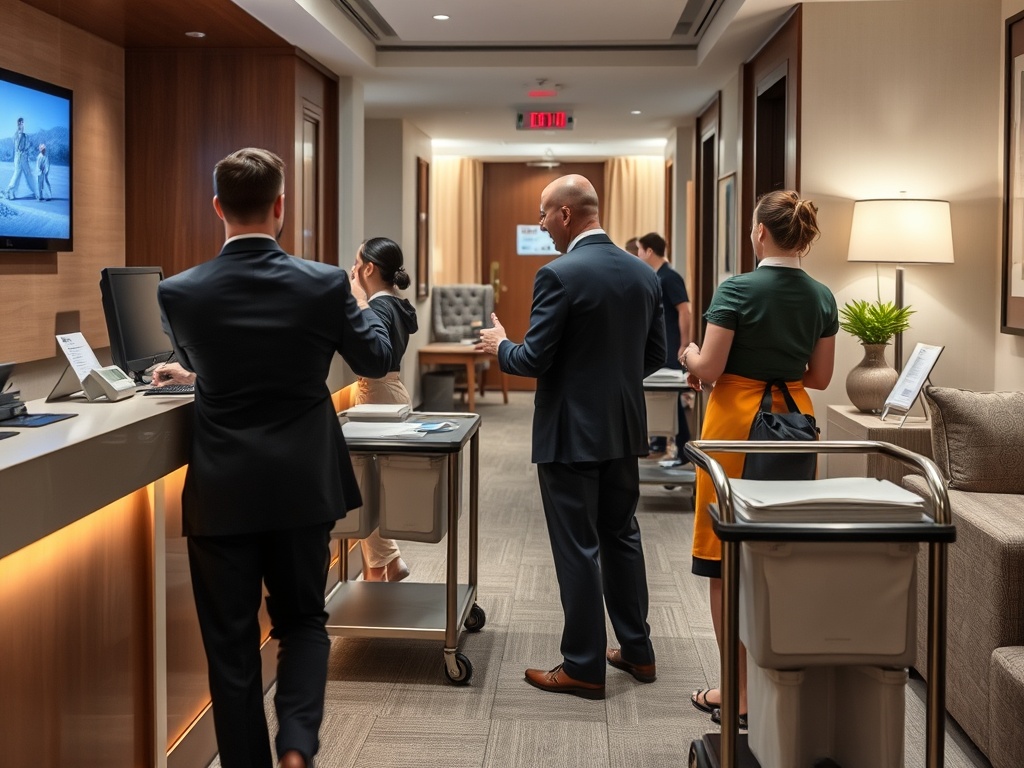

Hotels balance service and profitability by protecting the guest experiences that drive trust and repeat demand while controlling the labor, distribution, operating, and amenity costs that do not create equivalent value. The goal is not to “cut service”; it is to spend deliberately where service quality and economic return reinforce each other.
TL;DR — Service-and-Profit Priorities
- Measure profit by guest segment and service touchpoint, not room revenue alone.
- Protect high-impact moments such as arrival, cleanliness, problem resolution, and sleep quality.
- Test cost changes against guest effort, complaint risk, labor impact, and downstream revenue before scaling them.
Define the Service Promise Before Cutting Cost
Balancing service and profitability begins with identifying which service moments genuinely influence guest effort, loyalty, recovery costs, and total revenue. Managers should distinguish visible guest value from legacy processes that consume labor without improving the stay. The useful question is not “Where can we cut?” but “Which operating choices reduce friction while preserving the economics of the guest relationship?”
Guest-critical moments
Identify where failure has a disproportionate effect: reservation accuracy, arrival, room readiness, cleanliness, maintenance response, billing, and recovery.
Total guest value
Look beyond room revenue to food and beverage, spa, meetings, ancillary spend, repeat demand, and acquisition cost.
Cost-to-serve
Track labor time, consumables, distribution fees, third-party commissions, complimentary services, and rework created by service failures.
Cornell hospitality research on total hotel revenue management describes a shift from rooms-only revenue thinking toward broader customer value and strategic profit management. That supports a practical operating principle: judge service decisions by their effect on the whole guest relationship and total economics, not a single departmental budget.
Follow Profit Across the Whole Guest Journey
Evaluate service decisions across the full cost chain rather than one department’s budget. A front-desk shortcut that creates housekeeping rework, repeated guest contacts, or compensation can be more expensive than the labor it appeared to save. Likewise, an amenity with modest direct revenue may support rate, retention, or ancillary spend if it removes a recurring pain point for a valuable segment.
Operational consistency
A small benefit delivered reliably can create more confidence than an expensive feature that is frequently unavailable.
Recovery economics
Fast, empowered problem resolution can prevent a minor defect from becoming a larger refund, compensation, or reputation cost.
Operators evaluating service changes for mixed work-and-leisure demand can compare this approach with tips for combining work and leisure stays. That traveler-side view helps identify which service moments become more important when a room also functions as a temporary workplace.
Different Guest Segments Value Different Touchpoints
Different guest segments notice different service failures. A conference guest may care most about arrival speed and billing accuracy, a family about room readiness and predictable dining, and a premium leisure guest about coordination across departments. Segment the service journey before setting universal priorities so investment follows the moments that actually shape each stay.
| Traveler type | What to prioritize |
|---|---|
| Luxury and premium guests | Consistency, personalization, response speed, and staff discretion may justify higher service intensity when those expectations are built into the rate. |
| Select-service guests | Speed, cleanliness, simple digital processes, and dependable basics can matter more than a wide menu of staffed amenities. |
| Group and business guests | Predictable check-in, billing accuracy, meeting support, and schedule coordination can outweigh individual leisure features. |
Operational trade-offs should be made explicitly. When one team proposes a cost reduction, document the expected saving, the guest touchpoints affected, the workload transferred elsewhere, and the metric that will show whether the change worked. That prevents a local efficiency from being mistaken for a property-wide improvement.

Use Data Without Turning Hospitality Into a Spreadsheet
Before rolling out a service change, test the assumption behind it. Review complaint categories, repeat-contact volume, compensation, labor minutes, conversion or upsell effects, and any guest-experience signal that can be measured consistently. A small pilot with a clear baseline usually provides better evidence than a property-wide cut based on anecdote.
Questions for Testing a Service Change
- Which service failures generate the most rework, compensation, or repeat contacts?
- Which benefits are highly valued by a narrow segment rather than the whole guest base?
- Can a process change reduce both staff effort and guest effort at the same time?
- Does the proposed cut move cost elsewhere, such as housekeeping delays becoming front-desk complaints?
- How will the change be tested before property-wide rollout?
Keep the rationale, baseline, pilot period, and outcome measures together so the decision can be reviewed later. Service operations change with staffing, seasonality, and guest mix, so a result from one period should not automatically become a permanent rule. Revisit the economics when conditions shift rather than letting a temporary workaround harden into standard practice.
Trim Friction Before Trimming Care
Be wary of savings that simply move work from one department to another or push inconvenience onto the guest. Removing a benefit can also backfire when the replacement process is harder to understand or use. The traveler-side logic in tips for maximizing resort credits is a useful reminder that an advertised benefit creates little value when redemption is confusing, restrictive, or disconnected from what guests actually want.
- Across-the-board cost cuts with no guest-impact hypothesis.
- Using average revenue without accounting for acquisition and servicing costs.
- Adding technology that creates another channel guests and staff must monitor.
- Removing a visible service while leaving the underlying operational waste untouched.
Operational risk compounds when several fragile processes touch the same stay. A delayed room, understaffed front desk, unavailable dining outlet, and slow recovery path can turn minor defects into compensation and negative sentiment. Map those dependencies before reducing staffing or service coverage, especially during periods when occupancy, events, or arrival peaks tighten the system.
A Management Test for Service Investments
Rate proposed changes on guest impact, profit impact, implementation effort, failure risk, and reversibility. Add a written hypothesis beside each score, such as “reduces repeat calls by combining two handoffs.” The hypothesis matters because it can be tested; a numerical rating without a mechanism is only an opinion expressed as a number.
- Guest impact
- Profit impact
- Operational effort
- Failure risk
- Reversibility of the change
Some standards should function as operating guardrails rather than variables in a scoring model. Safety, regulatory requirements, essential accessibility, and commitments already sold to the guest cannot be traded away for short-term savings. Use comparative scoring only after those obligations are protected.
Stress-test the change under peak conditions, not only on an average day. Ask what happens when arrivals bunch together, a key system fails, an employee calls out, or a high-value guest needs recovery at the same time. A process that saves money only when operations are quiet may create costly exceptions exactly when the property has the least spare capacity.
Protect the Moments Guests Actually Remember
The strongest service-profit decisions are specific: protect the moments guests notice, redesign the steps that create unnecessary effort, and measure the total economic effect. When a cost reduction makes the stay harder, it should face the same scrutiny as any other investment decision.
The strongest service-profit decisions remove waste without removing care. Protect the moments guests notice, simplify handoffs that create rework, measure the total economic effect, and reverse changes that save locally but damage the broader stay or customer relationship.